What is Animal Farm About
We begin by answering the search directly: this short novel tells of farm animals who rise up against their human owner, seek equality, and then watch their dream twist into a new form of oppression. The plot moves fast, but its satire runs deep.
In this Ultimate Guide, we preview the plot, introduce main characters, and unpack the key symbolism without spoiling crucial surprises. We call it a novella that reads like a parable, using simple scenes and sharp satire to carry weighty ideas.
We explain george orwell’s aim: to warn how revolutions can be taken over and sold as progress. We will track the animals’ uprising, the shifts in power, and the final, bitter outcome that echoes real history.
Our account keeps the story clear for U.S. students and general readers. We will link the tale to the Russian Revolution and Stalinism while keeping language plain, so readers can follow the political meaning and moral lessons with ease.
Animal Farm in a nutshell: a political satire told as a beast fable
In short, the tale uses simple animals to carry a sharp political punch. We describe the format first: a beast fable that reads like a children’s legend but works as adult critique.
The book blends satire, dystopia, and allegory. Satire mocks power; dystopia shows how hopes decay; allegory links characters to real-world figures. Together they make a fast, clear narrative.
- The novella arrived in 1945, after a major global conflict, so its warning felt urgent at the time.
- The core setup: exploited animals rise, set rules, and aim for equality, freedom, and a better life.
- Slogans and painted rules serve as quick truths that later get twisted into propaganda.
| Format | Goal | Outcome |
|---|---|---|
| Beast fable | Equality | Dystopia |
| Satire | Freedom | Betrayal |
| Allegory | Better life | Corruption |
What is Animal Farm About: the core story and big idea
We trace how a hopeful uprising turns into a tight grip by a new ruling few. The core story shows a fast shift from shared rules to one class that claims special rights.
From uprising to betrayal
At first, the revolution feels real. The animals unite around clear ideals and simple rules.
That unity cracks when leaders concentrate power. Promises of shared labor and reward give way to privileges for a handful.
When “animals equal” becomes a warning
The phrase animals equal starts as hope and then reads like a caution. Leaders justify extra rations and separate housing by saying it helps others.
- We explain the big idea plainly: revolts can be taken over by a new elite.
- We note the turning point from shared leadership to concentrated power.
- We show how slogans collapse into tools for control and how fear helps rulers keep others compliant.
George Orwell and the real-world inspiration behind Animal Farm
We place the novella in its historical frame to show how real events shaped Orwell’s tale.
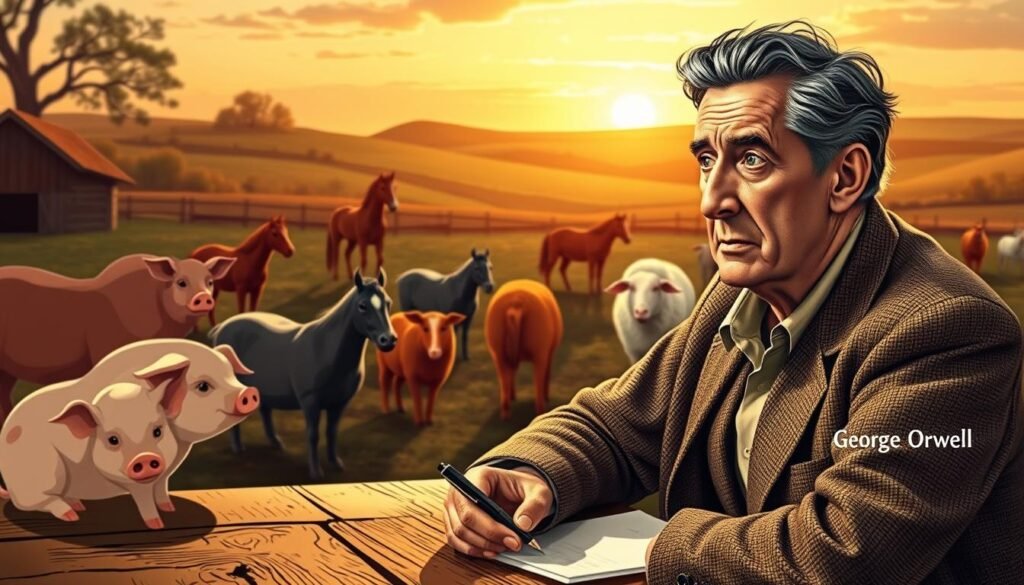
Orwell said the book mirrors the events that led up to the russian revolution of 1917 and then into the Stalinist era of the soviet union. He called it “a satirical tale against Stalin” and later noted this was his first work to fuse political purpose and art.
How the russian revolution shaped the plot
The farm works as a compressed model of revolutionary Russia. Early hope, bargain for power, and then centralization mirror the revolution’s arc.
From 1917 to Stalinism: the historical arc Orwell critiques
We map the broad flow: 1917 uprising → consolidation of power → propaganda and purges. That sequence helps link novel scenes to real events without a history degree.
Orwell’s political purpose: a satirical tale against Stalin
- Orwell’s democratic socialist stance explains his target: joseph stalin’s regime, not equality itself.
- The book warns how leaders use the people as cover while building a protected elite.
- Written during wartime (1943–44) and published in 1945, the novel risked controversy at the time.
| Historical Phase | Novel Parallel | Key Figure |
|---|---|---|
| 1917 uprising | Rebellion against Jones | tsar nicholas |
| Power consolidation | Pigs seize control | joseph stalin |
| Purges & propaganda | Show trials and slogans | Party elites |
Setting the stage at Manor Farm: neglect, anger, and Old Major’s vision
Neglect and hunger set the scene at Manor Farm, making revolt feel like fate. The poorly run property near Willingdon shows barns in disrepair and food in short supply.
Mr. Jones as the failing farmer
Mr. Jones appears as an irresponsible, alcoholic farmer. His neglect drives the animals to desperation.
Orwell links this failing owner to tsar nicholas by showing a collapsing authority and loss of respect.
Old Major’s speech and the song
Old Major stands aside from politics as a wise pig who sparks the dream of self-rule.
He teaches “Beasts of England,” an anthem that binds the animals and gives them a shared goal.
- Manor Farm’s conditions—hunger, cold, and hard work—explain why revolt seems worth the risk.
- Mr. Jones embodies a failing ruler, which opens the path to change.
- Old Major’s ideas later shrink into slogans, leaving room for manipulation once leaders rise.
| Element | Role | Effect |
|---|---|---|
| Manor Farm | Setting | Breeds resentment |
| Mr. Jones | Failing farmer | Loss of authority |
| Old Major | Ideological spark | Unifies animals |
The rebellion and early “Animalism”: hope, rules, and first cracks in equality
When the animals seize control, their victory feels both thrilling and dangerously fragile. We watch joy mix with the long labor ahead. The humans are driven off, and the group renames the property to mark a new start.
Driving out humans and renaming the manor
Driving off the humans signals that the old order has fallen. The new name—Animal Farm—declares a break. It also gives the animals a common identity to rally around.
The Seven Commandments on the barn
They paint the Seven Commandments on the barn as a public charter. “All animals are equal” sits at the center. The rules feel like a constitution the group can trust.
Early privileges and the first cracks
Quickly, the pigs place themselves in supervisory roles. They reserve milk and apples, saying these items aid leadership and health.
- The revolt brings authority and immediate chores; the animals work hard to keep the farm running.
- Small exceptions—food and oversight—start as practical measures and then suggest entitlement.
- We sense how control over literacy and memory will turn the commandments into a battleground.
| Action | Symbol | Effect |
|---|---|---|
| Rename | New identity | Unity |
| Paint rules | Seven Commandments | Trust |
| Pigs lead | Reserved food | Inequality |
Main characters and what they represent in the allegory
We introduce each key figure, linking personality to political purpose. The cast serves as functions in the revolt, not just individuals. That makes the novella work as an allegory.
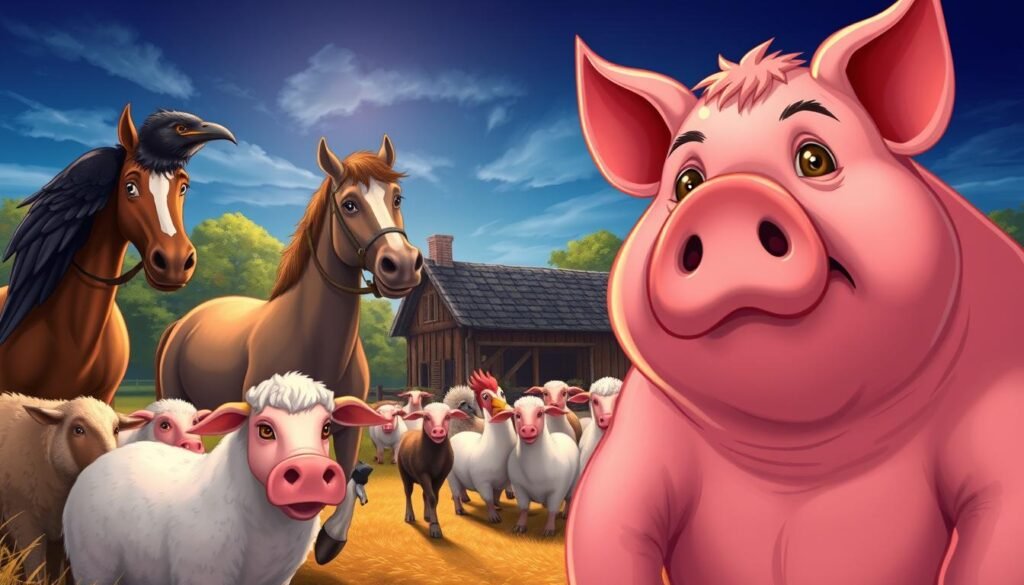
Napoleon vs. Snowball
Napoleon stands for Joseph Stalin while Snowball echoes Leon Trotsky. Their rivalry turns debate into force and moves the animals from hopeful self-rule to authoritarian rule.
Squealer and propaganda
Squealer rewrites facts to protect leaders. He turns contradictions into necessary policy and makes the pigs’ choices seem inevitable.
Boxer, Clover, Benjamin
Boxer represents tireless labor and naive trust. Clover shows care and growing doubt. Benjamin offers bleak skepticism, sensing how power corrupts.
Humans and Moses
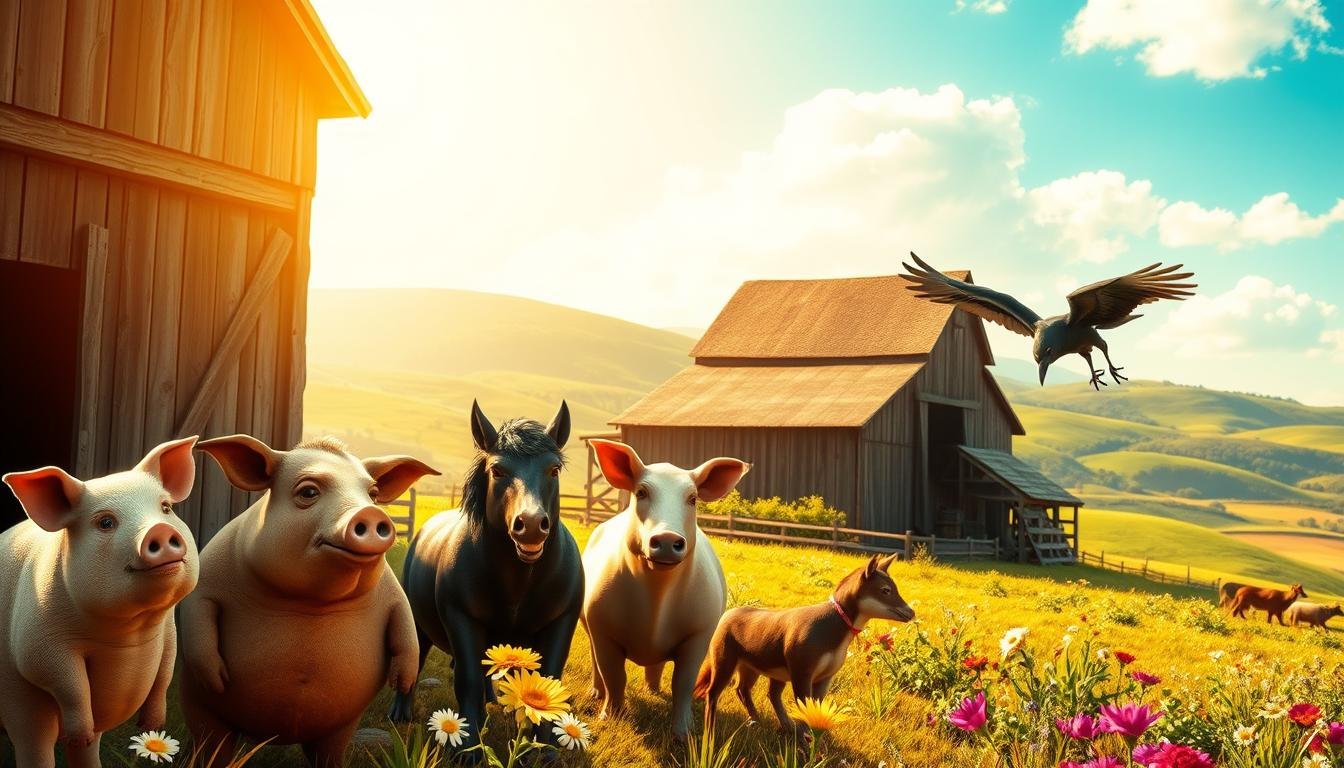
Mr. Jones, Frederick, and Pilkington act as outside pressure and opportunism. Moses the raven offers Sugarcandy Mountain, a promise that soothes workers and validates complacency.
- Each character maps to a political role or social force.
- Leadership, propaganda, labor, and religion all shape the fallen promise.
- The pigs transform ideals into tools of control.
| Character | Role | Allegory |
|---|---|---|
| Napoleon | Leader | Joseph Stalin |
| Snowball | Idealist/Planner | Leon Trotsky |
| Squealer | Propagandist | State media |
Key events that shape the farm’s rise and fall
A string of decisive events reshapes the farm’s future and exposes the pigs’ appetite for power.
The Battle of the Cowshed
Humans try to retake the property under Mr. Jones, but the animals repel them. The victory briefly unites the group and creates heroes.
Leaders later use the battle to rewrite history and reward loyalty rather than deserve true equality.
The windmill debate and Snowball’s exile
The push to build windmill divides opinion. Snowball argues for progress; Napoleon resists until he seizes power.
Napoleon’s dogs chase Snowball away, ending open debate and letting the pigs set the order.
Purges, executions, and rule by fear
Show trials and sudden executions enforce obedience. Confessions replace discussion and terror enforces silence.
Frederick’s betrayal and the windmill’s destruction
Frederick pays with forged money, then attacks. The windmill is smashed, showing how outside threats magnify internal decay.
Boxer’s collapse and the knacker’s van
Boxer, the hardest worker, collapses from overwork. He is sold and taken away; Squealer lies about his fate.
That final betrayal signals how the pigs discard the very labor that built their order.
- Battle unites then becomes propaganda
- Windmill fight ends debate and centralizes power
- Purges turn rule into a police state
- Betrayal from outside destroys progress
- Boxer’s removal reveals moral collapse
| Event | Immediate Effect | Long-term Result |
|---|---|---|
| Battle of the Cowshed | Unity and heroes | Propaganda tool |
| Snowball’s exile | No debate | Pig dominance |
| Windmill destroyed | Material loss | Weakened morale |
The Seven Commandments over time: how power rewrites the rules
We watch the barn wall change as power finds ways to bend rules to fit desire. The seven commandments start as clear law. They end as slogans that serve a few.
Why the rules shift as control tightens
The pigs deny problems, then reinterpret facts to suit their needs. They edit lines on the wall. Each edit makes their authority firmer.
From “four legs good” to “two legs better”
We track the slogan shifts. The move from two legs bad to two legs better marks a clear betrayal. The change shows how leaders become what they once condemned.
The final twist: equality turned upside down
At last the commandments collapse into one grim line: all animals are equal, but some animals are more equal than others. That phrase turns animals equal into a lie. It makes equality a cloak for privilege.
| Stage | Method | Effect |
|---|---|---|
| Denial | Ignore evidence | Confusion among animals |
| Rewrite | Edit commandments | Pigs gain control |
| Declare | Claim permanence | Privilege for equal others |
Themes that explain Animal Farm’s lasting impact
We map the book’s core lessons so readers can spot power at work in stories and life.
Power and control: revolutions may replace one ruler with another. Once leaders gain authority, they expand it by building guards, privileges, and fear. That pattern shows how a hopeful change can become a closed system ruled by a few.
Power and control: how revolutions can create new tyrants
Leaders centralize decisions and limit debate. The result is a small group that lives differently from others. We see how power grows by protecting itself.
Lies and propaganda: language as a weapon
Repetition and slogans simplify truth. Language becomes a tool to confuse, justify, and erase facts. That kind of control bends public memory and reshapes what people accept.
Hope and betrayal: what happens to ideals over time
Initially, ideals inspire unified effort and honest work. Over time, “practical” exceptions favor the rulers. The gap between promise and daily life shows the cost of betrayal.
| Theme | How it appears | Effect on lives |
|---|---|---|
| Power | Guards, rules, privileges | Unequal leadership |
| Propaganda | Slogans, rewrites, silence | Distorted truth |
| Hope vs. Betrayal | Promises → compromises | Loss of trust and toil |
How Orwell uses language and structure to sharpen the message
Orwell sharpens his critique by pairing spare prose with a tightly ordered plot. That pairing makes the moral feel immediate and clear.
We first note the fable technique. The surface reads simple: short scenes, clear motives, and steady cause-and-effect. That simplicity forces readers to face the moral without distraction.
Fable techniques: simple surface, serious moral
The beast fable style turns complex politics into everyday choices. Animal actions stand for human moves. The plain voice keeps the lesson visible.
Allegory mechanics: characters and events with hidden meaning
Characters double as political figures and symbolic types. Slogans, set pieces, and even the commandments work on two levels at once.
Cyclical narrative: why the ending mirrors the beginning
Orwell arranges events so small rule-bending escalates into full corruption. The final scene returns the farm to a familiar order, showing the novel’s tight, circular design.
- Plain language makes persuasion visible.
- Allegory links scenes to history without heavy exposition.
- The rewritten commandments let us watch truth change in real time.
Why Animal Farm still matters to us today
The novel keeps speaking to us because the closing image makes its warning plain: rulers who claim change can end up mirroring the old order. That final scene forces a clear question about people and power in our time.
What the final scene says about people, power, and corruption
We read the last pages as a lesson in interchangeability. The pigs trade hooves for boots and whips, and the animals cannot tell them from men.
This collapse of rules shows how easily ideals can be hollowed by those who crave control. Orwell ties the story to the russian revolution and the soviet union, but the moral goes beyond one era.
How the book helps us spot manipulation in modern politics and media
We learn to watch for repeated slogans, staged meetings, and selective facts. These tactics shape belief more than truth does.
By studying language and scenes, we gain tools to spot spin, whether in news, campaigns, or online feeds.
What to watch for when rereading: slogans, scapegoats, and “necessary” sacrifices
On a second read, early cues stand out: small privileges, word shifts, and quiet scapegoating. They build into larger betrayals.
- Slogans that simplify complex issues
- Blame placed on rivals to distract people
- Claims that sacrifices are always “necessary” for progress
| Sign | How it appears | Why it matters |
|---|---|---|
| Slogan-first language | Short, repeated phrases | Shapes acceptance over debate |
| Rewritten rules | Edits or excuses | Normalizes privilege |
| Scapegoating | Blame shifted to rivals | Divides people and hides fault |
| Elite mimicry | Rulers adopt old ways | Shows corruption complete |
Taking the lesson with us: what Animal Farm ultimately warns us about
We carry the novel’s final warning into everyday questions about power and trust.
By the end of animal farm the pigs adopt human ways, the barn rules collapse, and the farm name even returns to Manor Farm. That cyclical turn shows how easily ideals bend when truth is controlled.
The windmill starts as promised progress and then becomes a demand for more work. Boxer’s fate—sold and gone—marks the real cost: loyalty meets betrayal and death when systems value control over justice.
We leave with a clear task. Notice small exceptions, challenge rewritten records, and ask when leaders ask others to sacrifice who benefits, who pays, and what rule changes allow it.
Reading orwell animal farm or george orwell’s novella this way helps us spot manipulation in our way of life.