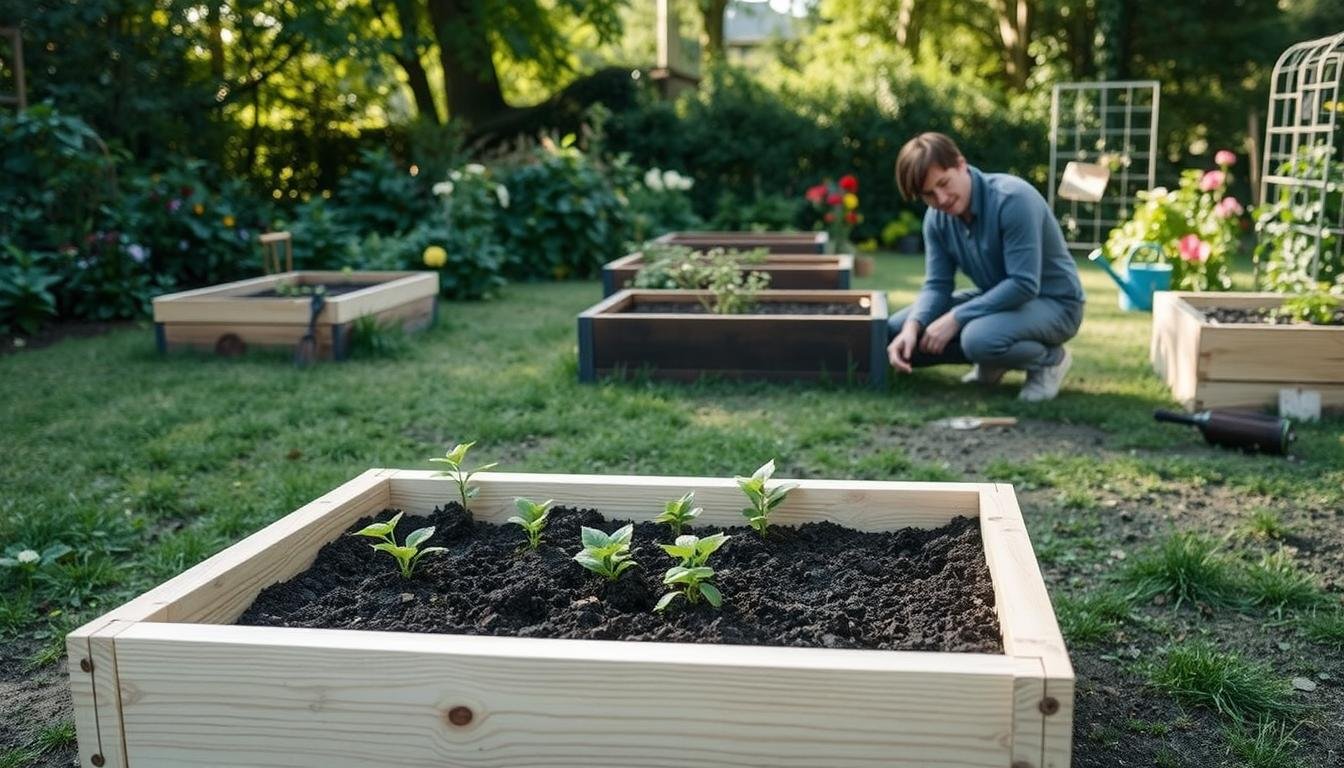
How to Build Raised Garden Beds
We wrote this as a practical, experience-based DIY guide for a U.S. backyard. Our aim is simple: we want readers to plan a layout, pick materials, prep the site, and finish a square, level frame that lasts.
By the end, we will have learned key steps and checkpoints. You will learn build choices that affect cost and lifespan, such as cedar versus pine, bed height, and whether to add hardware cloth or support mid-span.
Raised beds are basically simple boxes, but details matter. Leveling, squaring corners, and proper reinforcement prevent bowing and extend life.
We also set realistic budgets: past “$100 bed” estimates shift with lumber prices. The rest of this article breaks down planning, materials, step-by-step assembly, finishing options, and soil so you can skip common mistakes and finish with a productive bed.
Why we build raised garden beds in the first place
We chose raised frames when our backyard soil proved heavy and stubborn. Framing soil into contained beds gives us control over composition, drainage, and access. That control often turns poor ground into productive planting areas.
Better soil and drainage
When native ground is clay or depleted, a raised bed lets us bring in a richer mix of topsoil and compost. The looser soil encourages deeper roots and better yields.
Comfort and cleaner layout
Even a modest bed height cuts bending during planting, weeding, and harvest. Defined edges create tidy garden beds and clear walkways, which keeps weeds out of paths.
| Benefit | When it matters | Practical result |
|---|---|---|
| Improved soil | Clay or low organic matter | Better root growth and yields |
| Drainage | Low spots or heavy rain | Less waterlogging, earlier spring planting |
| Ergonomics & tidy beds | Small yards, frequent gardening | Less strain, fewer weeds in paths |
The benefits depend on smart placement, spacing, and sizing. A thoughtful layout is the best way to make framed beds work long term.
Planning your raised bed garden layout for a U.S. backyard
We began planning by watching sun patterns in our yard over several afternoons. That simple habit showed where vegetables would get six to eight hours of direct light most days.
Pick a sunny place
In the northern hemisphere a south-facing open area is usually best. We avoided spots near trees, tall fences, or structures that cast midday shade.
Orientation that cuts shading
We aligned most frames north–south so tall tomatoes and trellises cast less shade on lower plants. That orientation helped even light across rows as the season progressed.
- Target 6–8 hours of direct sun for common vegetables.
- Leave pathways of at least 28 inches; 36–48 inches is ideal for a wheelbarrow or garden cart.
- Lay boards or rope on the ground first and walk the layout before you fix anything.
| Factor | Recommendation | Why it matters |
|---|---|---|
| Sun exposure | 6–8 hours | Improves flowering and yields for most plants |
| Orientation | North–south | Reduces crop shading during peak time |
| Path width | 36–48 inches preferred | Room for wheelbarrow, easy maintenance access |
Spacing also keeps beds from shading each other and preserves usable space as plants fill out. Our sizing choices next will match reach and tools, not just yard limits.
Choosing the right raised garden bed size and height
Our sizing choices grew from asking one simple question: can we reach the center without stepping in?
Width and access
We follow the reach rule: keep width at four feet so we can work from either side. Against a fence, we shrink the width to three feet since access comes from one side only.
Length and durability
Long boards face more outward soil pressure. We cap most beds near eight feet and avoid going past ten feet unless we add mid-span supports.
Depth and crop needs
Many vegetables do best with about 16–18 inches of loose soil. That depth supports roots and helps hold moisture.
- Keep width ≤ 4 feet (≤ 3 feet at a fence).
- Limit length ≈ 8 feet; 10 feet max with reinforcement.
- Aim for 16–18 inches of depth, achieved by stacking boards.
| Common size (ft) | Use | Notes |
|---|---|---|
| 4 x 8 | Standard veg rows | Good balance of access and length |
| 4 x 6 | Smaller yards | Easier to handle boards |
| 2 x 6 / 2 x 8 | Pathway-friendly | Works as narrow garden bed |
| 4 x 4 | Square plots | Simple, modular layout |
Remember that nominal lumber affects final height. Stacking boards usually gives the 16–18 inch finished bed we want. Next, we pick lumber, tools, and hardware that match these size decisions.
Picking lumber and boards that last for years
Choosing the right lumber makes the difference between a short-lived frame and one that serves us for years.
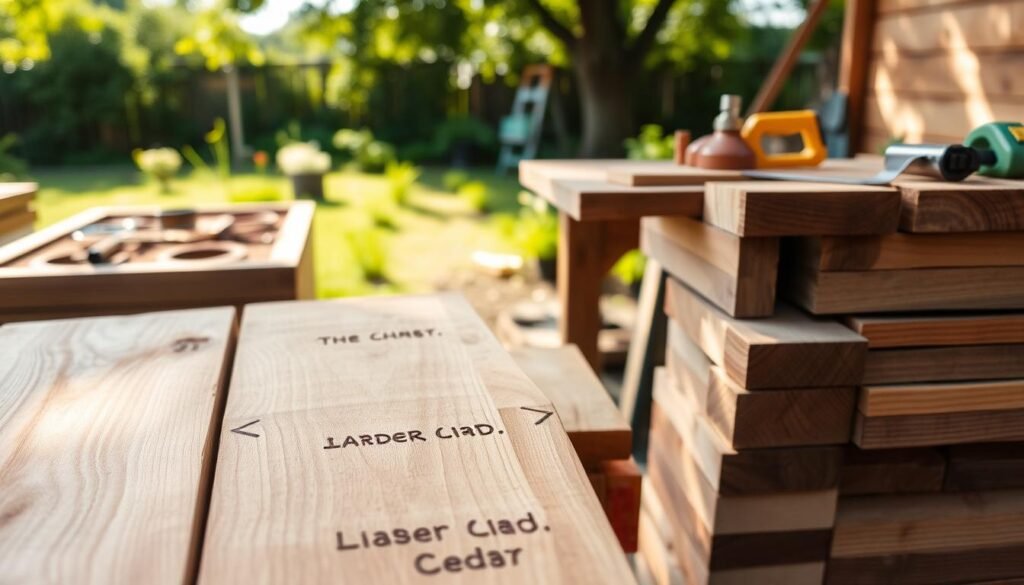
Cedar, redwood, and durable choices
Cedar and redwood resist rot naturally and often last a decade or more in typical U.S. yards. We pick these when longevity and a clean look matter.
Pine, Douglas fir, and budget options
Pine and Douglas fir cost less and work well for short-term projects. Expect lifespans of roughly three to seven years depending on rain, heat, and soil moisture.
Modern pressure-treated options
Modern pressure-treated lumber commonly uses Micronized Copper Azole (MCA) instead of older arsenic formulas. If we use it, we plant a few inches away from the inside side and seal the wood with a food-safe product.
- At the hardware store we sight down each board for twist and bow.
- Avoid boards with large cracks or severe crown that will cup outward.
- Choose thicker boards (2×6 or 2×8) to reduce bowing and reinforcement needs.
| Material | Typical lifespan | Notes |
|---|---|---|
| Cedar / Redwood | 10+ years | Rot-resistant, ages well |
| Pine / Douglas fir | 3–7 years | Lower cost, variable with climate |
| Pressure-treated | 7–15 years | Modern MCA treatments; place edibles inward |
Tools and materials we gather before build time
Before we cut a single board, we gather every tool and material that keeps the job smooth and safe. Laying out gear first saves us trips and keeps measurements consistent as we work.
Core hand and power tools
We bring a tape measure, a reliable level, a drill/driver, and a speed square for clean corners.
A circular saw or miter saw handles repeated cuts. Sawhorses give a stable cutting surface and improve safety.
Fasteners and reinforcement
For exterior durability we specify 2.5–3 inch galvanized deck screws for all structural joints. Those screws resist rust and hold long term.
For longer spans we pack galvanized mending braces and braces for corner reinforcement as optional hardware.
Protection and ground prep
- Hardware cloth under the frame for burrow defense (preferred over chicken wire).
- Heavy-duty landscape fabric for weed suppression while allowing drainage.
- Extra screws, stakes, and a small shovel for anchoring corners.
| Item | Why | Note |
|---|---|---|
| Level | Keep sides flat | Use often during each step |
| Drill/driver | Fasten quickly | Bring spare bits and batteries |
| Screws | Long-lasting joinery | Galvanized 2.5–3 in |
Gathering everything ahead of time keeps each step efficient and saves time at the build site. With materials ready, we stay focused and finish sturdy beds faster.
Design choices that make building raised beds easier
A few early decisions about corners, board height, and actual dimensions make the whole project much easier.
Corner posts versus driven stakes
We compare two reliable corner strategies: cut 4×4 posts set at the finished height, or drive 2×4 stakes into the ground and fasten boards to them. 4×4 corners give a clean, rigid frame that is easy to square on a level surface.
Driven stakes work well on uneven ground because they anchor each corner where it sits. Stakes can be faster when we build in place and don’t need precise off-ground assembly.
Choosing 2×6 or 2×8 for the sides
For the bed sides we usually pick either 2×6 or 2×8 boards. A 2×8 reduces flex and often needs fewer stacked courses than a 2×6 when we want more depth.
Thicker boards mean less mid-span reinforcement on longer runs. For runs over six feet we plan supports regardless of board height.
Nominal versus actual lumber size
Remember that a labeled 2×6 is about 1.5 inches by 5.5 inches in real size. Those real inches determine final height when we stack courses.
Measure actual board width before final cuts. A quick mental math check—three nominal 2×6 courses usually give about 16.5 inches, not 18—helps us avoid surprise gaps or overcuts.
- Use 4×4 posts for neat corners and easy squaring.
- Pick driven 2×4 stakes when ground is uneven.
- Measure actual board widths and plan cuts to hit target bed dimensions.
| Choice | When we use it | Benefit |
|---|---|---|
| 4×4 posts | Level sites, pre-assembled frames | Rigid corners, easy squaring |
| 2×4 stakes | Uneven ground, in-place builds | Anchored, adaptable |
| 2×6 boards | Standard depth goals | Lower cost, lighter |
| 2×8 boards | Deeper beds, fewer stacks | Less flex, cleaner look |
Preparing and leveling the ground for a raised garden bed
We start by stripping sod and roots until the ground will hold a straight edge.
Good site prep makes the rest of the project faster and more reliable. This short process protects corners and keeps the frame from shifting as soil settles.
Clearing grass, roots, rocks, and compacted soil
Remove sod and surface weeds so the frame sits flush. Pull roots and pick rocks from the footprint so nothing creates pressure points under boards.
Loosen compacted soil beneath the frame a few inches. That helps drainage and reduces future settling that can twist the sides.
Using a level and a shallow trench on slopes
On a slope we dig a shallow trench at the low side and set the first board into it. Then we shave soil from the high side until the board reads level across its length.
We check with a long level and re-dig small spots until the first course is true. That first course is the most time-consuming step because every stacked board copies small errors.
Squaring corners early to avoid later problems
Before fastening, we check square with a framing square or the 3–4–5 method. Adjust the footprint now; once screwed, errors are costly and hard to fix.
Think about water flow and pathways while the site is open. Small changes now save time later and confirm real measurements before we cut lumber.
| Action | Purpose | Estimated time |
|---|---|---|
| Remove sod & roots | Create a flat, stable ground | 20–40 minutes per 4×8 place |
| Loosen compacted soil | Improve drainage, prevent settling | 10–20 minutes |
| Dig shallow trench on slope | Set first board level across run | 15–30 minutes |
| Check square corners | Prevent misaligned stacked rows | 5–15 minutes |
Cutting boards to length without wasting lumber
On every project we treat each board as unique and cut only as required. We measure twice and mark clearly. That practice keeps waste low and corners clean.
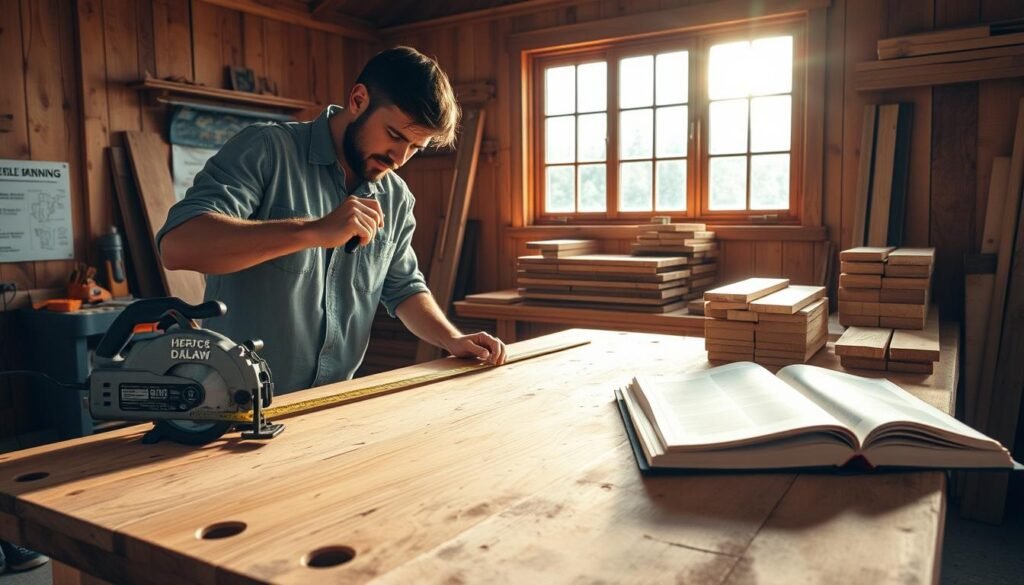
Measuring twice and cutting once for clean corners
Measure the finished outside length in inches before any cuts. Mark one board and cut it, then test-fit at the corner. Make sure the fit is snug before repeating the cut for matching pieces.
When to cut short sides slightly smaller for exact outer dimensions
If short sides sit between long sides, reduce short board cuts by about 3 inches (roughly 1.5″ per overlap). That sandwich math hits the planned outside length without forcing corners or splitting wood.
Safety notes for circular saw and miter cuts
Use stable sawhorses, clamp the board, and set blade depth just past the board thickness. A speed square helps guide straight cuts and accurate 45-degree miter marks if you add a top cap later.
| Action | Typical value | Why it matters |
|---|---|---|
| Measure & mark | Exact inches | Prevents wasted length and mismatched corners |
| Short-side reduction | ≈ 3 inches | Accounts for long-side sandwich overlap |
| Cut test piece | 1 board first | Confirms length before mass cuts |
| Safe cutting | Use saw, clamps, sawhorses | Reduces kickback and prevents bad holes |
Make sure every cut is confirmed with real measurements. Clean, accurate cuts reduce forced gaps and misaligned holes. That preparation makes the next assembly step faster and far neater in the process.
How to Build Raised Garden Beds step by step
Our build starts on the ground: the first course sets the final footprint. We place each board where the frame will sit and adjust soil under the boards until every side reads level with a long level.
Laying out the first course and keeping sides level
We lay the first course in place and check level frequently. Small soil shims under boards fix low spots quickly. Take time now; a true first course prevents leaning later.
Fastening corners and drilling pilot holes
At every corner we drill pilot holes near board ends to stop splitting. Then we drive 3-inch galvanized deck screws in a pattern that uses multiple screws per joint so the frame resists outward soil pressure.
Checking square and adding corner supports
We square the frame with a framing square and re-check after the first screws. Finally, we add corner supports—driven 2×4 stakes or set 4×4 posts—so the corner stays tight as soil expands and contracts.
| Action | Why | Quick tip |
|---|---|---|
| Level first course | Prevents leaning | Use long level, adjust soil |
| Drill pilot holes | Prevents splitting | Place near ends, use proper bit |
| Add supports | Improves durability | Stake or post at each corner |
Building taller beds by adding a second row of boards
Before we stack any more lumber we measure the assembled first course and cut the next pieces to fit. Small variances in built length and corner overlap add up, so our second row must match reality rather than paper plans.
Cutting the next course from real measurements
We measure the outside length and the true board width at each side. Then we cut each board to that exact length in inches. That step helps the top course sit flush and avoids corner gaps.
Securing the second row so the sides don’t spread
Stack the second course carefully and align seams so the bed looks clean. We make sure the board edges line up and that fastener points clear the corners.
Fasten the second row into the same corner supports with 3-inch galvanized screws so the two courses act as a single unit. The main failure for taller beds is sides spreading outward under soil pressure; screws plus solid posts or stakes prevent that.
| Action | Why | Tip |
|---|---|---|
| Measure assembled frame | Accounts for real-world variances | Record length per side in inches |
| Cut next board course | Ensures flush corners | Cut one test piece first |
| Fasten into supports | Prevents sides spreading | Use 3-inch galvanized screws |
| Check level as you stack | Keeps sides plumb | Re-check after each screw |
We make sure to re-check level as we build upward. Long beds often need mid-span support in addition to corners; we cover that next.
Reinforcing long sides so boards don’t bow under soil pressure
Soil pressure on long spans tends to push outward where boards have the least support. That outward force makes the middle of a long side the first place we see permanent bowing over seasons.
Mid-span stakes and interior supports
Our simplest fix is a mid-span stake driven into the ground and screwed to the side at multiple heights. Place the first stake at the center of runs over six feet. Add another stake roughly midway between center and each corner on very long runs.
When we use galvanized mending braces
On beds longer than six feet we often fit slim galvanized mending braces. Braces pull boards straight and resist swelling. We use two per long run as a baseline and add more if the wood is thin or the span exceeds ten feet.
Fastening basics matter: use outdoor-rated hardware and consistent screw spacing so screws don’t loosen as boards move. With stakes or braces in place, a top cap or lip fastens more securely and the whole side looks straight and finished.
| Problem | Fix | Where | Fasteners |
|---|---|---|---|
| Middle bowing on long boards | Mid-span stakes | Center of run | Galvanized screws at 8–12 in spacing |
| Thin wood flexing | Galvanized mending braces | Inside face, behind board | Outdoor-rated screws, 2 braces per run |
| Very long spans (>10 feet) | Stakes + braces | Center and quarter points | Consistent hardware pattern |
Adding an optional top lip for seating and a finished look
A 2×4 cap around the rim upgrades the look and gives us a handy seat while we work. The lip protects the top edge and makes the frame feel built-in without much extra effort.
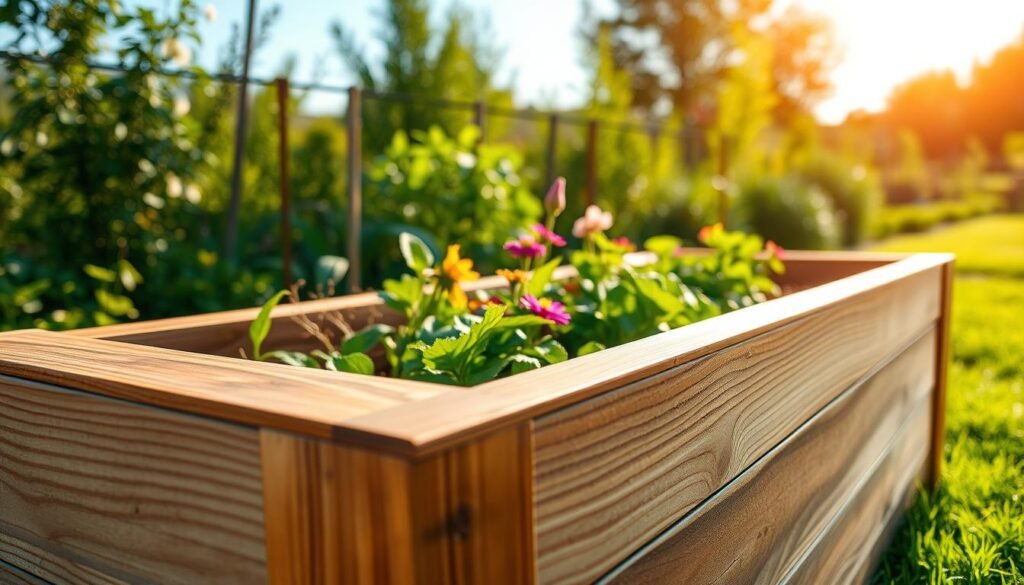
Measuring true top length before cutting
After the frame is assembled we measure the actual outside length on each side. Nominal sizes lie; make sure you record the real length at each run before you cut any board.
Making 45-degree miter cuts at the corners
Mark miter lines and cut with a miter saw so corners meet cleanly. Dry-fit the boards and adjust any small angle errors until seams close without gaps.
Fastening the lip into stakes and corner supports
Fasten the cap into stakes and corner posts, not only into end grain. Use 3-inch galvanized screws and secure miter joints with screws or glue so the cap stays tight through weather cycles.
- The lip acts as a short bench and ties the structure together on taller beds.
- Dry-fit all boards, then make final cuts and drive screws from the top into supports.
- Quick alignment checks before final fastening save re-cuts and keep corners square.
| Step | Material | Fastener | Tip |
|---|---|---|---|
| Measure top | 2×4 board | N/A | Record true length at each side |
| Cut miters | 2×4 boards | N/A | Use miter saw, test-fit pieces |
| Attach cap | Cap boards | 3″ galvanized screws | Screw into stakes or 4×4 corner supports |
| Secure joints | Boards and screws | Deck screws + optional glue | Fasten miter seams and check square |
Gopher-proofing and pest protection under raised beds
Pests that burrow can undo a season of work overnight if we leave the bottom open. We lined the footprint to stop gophers, moles, and other tunnellers from chewing roots and ruining soil structure.
Choosing the right mesh
We picked galvanized hardware cloth because it resists chewing and rust far better than chicken wire. Chicken wire will not block gophers; hardware cloth holds up in soil contact and lasts.
Fastening and finishing the mesh
Cut the mesh so it fully covers the bed base, then fold edges flat to reduce sharp points. Attach the mesh with wide-head cabinet screws that pinch the material to the boards; add staples between screws for speed.
Joining seams and common mistakes
If rolls aren’t wide enough, overlap seams by at least 3 inches and join with galvanized wire or heavy-duty zip ties. Make sure no small openings remain at corners or edges; pests will exploit any gap.
| Material | Fastener | Why |
|---|---|---|
| Hardware cloth | Wide-head screws | Blocks burrowers, resists rust |
| Staples | Between screws | Speeds installation |
| Galvanized wire / zip ties | Tied overlaps | Secures seams against pushing |
Weed prevention under and around garden beds
A low-weed garden begins at the framing stage, not after planting. We stop most problems by laying layers and keeping paths tidy before the frame is filled.
Landscape fabric that still allows drainage
We use heavy-duty, breathable landscape fabric under the frame and in high-traffic paths. Lay the fabric flat on the ground and overlap seams by 6 inches so seedlings can’t push through.
Pin the fabric and cut drainage slits where water must enter. Breathable fabric lets water pass but blocks root growth, so the soil inside the bed stays workable and drains well.
Keeping pathways clean to stop weeds from creeping in
Defined paths reduce seed and root spread. We cover aisles with mulch, gravel, or fabric and refresh these surfaces every season.
- Place fabric before adding mulch for best suppression.
- Combine hardware cloth under the fabric near edges for pest and weed control.
- Quick pathway touch-ups every few weeks cut weeding time in half during peak months.
| Method | Material | Benefit |
|---|---|---|
| Under-frame layer | Heavy-duty fabric | Suppresses weeds, allows drainage |
| Path cover | Mulch or gravel | Stops seeds, eases maintenance |
| Edge protection | Hardware cloth + fabric | Blocks burrowers and runners |
We remember that beds stay low-weed only if the surrounding ground is managed. The outside of the bed needs care for long-term service and minimal maintenance.
Sealing and finishing wood for longer life outdoors
A simple sealer can stretch the service life of our frames by several years. A non-toxic, food-grade finish protects wood that sits against soil and wet weather.
When we seal: before assembly vs. after the bed is built
Sealing before assembly is easiest. We can reach all faces of each board and coat hidden surfaces that trap moisture.
Sealing after the frame is built works, but it takes more time and may leave small gaps untreated. If we must seal after assembly, pay special attention to inside faces and corner joints.
Choosing a non-toxic, food-safe wood sealer
Pick a food-safe, water-based sealer labeled for planter contact. These products extend wood life without adding harmful chemicals near edible plants.
Cedar and redwood already resist rot and can last years unsealed. Pine or fir benefit most from sealing, especially in wet climates where boards stay damp for long stretches.
Simple application process
Clean and dry lumber before any finish. Apply at least two coats per manufacturer directions. Allow full cure time before filling the bed.
Make sure fastener heads and end grain get a coat. Sealing helps, but it does not replace good reinforcement, drainage, or mid-span supports.
| When | Pros | Cons |
|---|---|---|
| Before assembly | Full coverage of all surfaces; easier and faster | Requires space for drying; may need touch-ups after joining |
| After assembly | Can address site-specific wear and touch holes | Harder to reach hidden faces; more time-consuming |
| Material choice | Food-safe sealer works for pine/fir and treated lumber | Cedar/redwood still benefit but may need fewer coats |
Once the finish cures, we move on to filling the bed with soil. That next step is the biggest volume decision in this process and starts the real garden work.
Filling raised garden beds with soil and getting ready to plant
The soil we choose and how we layer it decides how well the bed performs in year one. We budget first, because filling a bed often equals or exceeds the lumber cost.
Planning for cost: bulk delivery vs. bagged soil
For several beds, bulk delivery usually saves money and trips. For a single 4 x 8 bed, bagged mixes can be convenient but pricier per cubic foot.
| Option | Cost per cubic yard | Best use |
|---|---|---|
| Bulk topsoil | Lower | Multiple beds, faster fill |
| Bagged mixes | Higher | Small projects, precise blends |
| Our recommended mix | Moderate | Topsoil + compost blend for crops |
Building a quality mix
We aim for a balance of drainage and moisture retention. A reliable mix is quality topsoil blended with well-aged compost and a small portion of screened loam.
- Target a 60/40 topsoil-to-compost ratio for most vegetables.
- Adjust particle size so roots find loose material down about 12–18 inches.
- Fill in lifts, water each lift, and top off after settling.
Planting near pressure-treated lumber
If we used pressure-treated lumber, we keep seeds and small transplants a few inches away from the inside edge. Plant heavier feeders toward the center where soil depth is greatest.
With soil settled and watered, we shift from build mode into active garden planning and planting. Our next step is scaling one good bed into a cohesive backyard layout.
From first bed to full garden: what we do next
One finished box gave us a real test plot for spacing, soil, and hardware choices.
We expanded slowly. We standardized bed size so buying boards, cutting lengths, and ordering soil became predictable. That saved time and reduced waste.
When adding rows we used stakes and string to keep lines true. We kept paths 36–48 inches so a wheelbarrow fits and tall plants don’t crowd neighbors.
Before filling future beds we planned irrigation runs and drip risers so we would not dig later. For soil, bulk delivery cut cost on multiple beds.
Our maintenance rhythm is simple: check screws and supports each season, top with compost, and watch sun and shade patterns for crop placement.
Next actions: pick the next bed location, confirm layout, buy straight boards, pre-cut, and repeat the level-and-square build process.